
Quick answer
What matters most.
Choose treatment only after defining the concern. Taste and odor, sediment, hardness, and a specific contaminant can require different technologies. Review the local water report, test when appropriate, verify third-party performance claims, and account for filter changes, flow, wastewater, and installation access.
Homeowner guide
The full guide.
If you've lived in St. George for any length of time, you already know the water here is hard - noticeably hard. Washington County's water supply pulls from the Virgin River and local groundwater sources, picking up calcium, magnesium, and a host of dissolved minerals along the way. The result is water that leaves white scale on your faucets, shortens the life of your appliances, and often has a taste that leaves something to be desired.
The good news: the right water filtration system should target the specific issue. The challenge is that “water filtration” covers a wide range of technologies, and not every solution is right for every home or every problem. This guide walks St. George homeowners through the most effective options, what they actually do, and how to decide which one belongs in your house.
Why St. George Water Is Especially Challenging
Hardness varies with the water source and blend. Review your retail water provider's report and test at the home before selecting treatment or programming a softener.
Calcium and magnesium can leave scale and spots. Taste, sediment, and suspected contaminants need separate assessment; appearance alone does not identify a contaminant or show that the water is unsafe.
Choose testing for the concern you want to investigate. A basic hardness test does not screen for every contaminant; a certified laboratory can advise on appropriate sampling and analysis.
The Main Types of Water Filtration Systems
1. Whole-Home Water Softeners
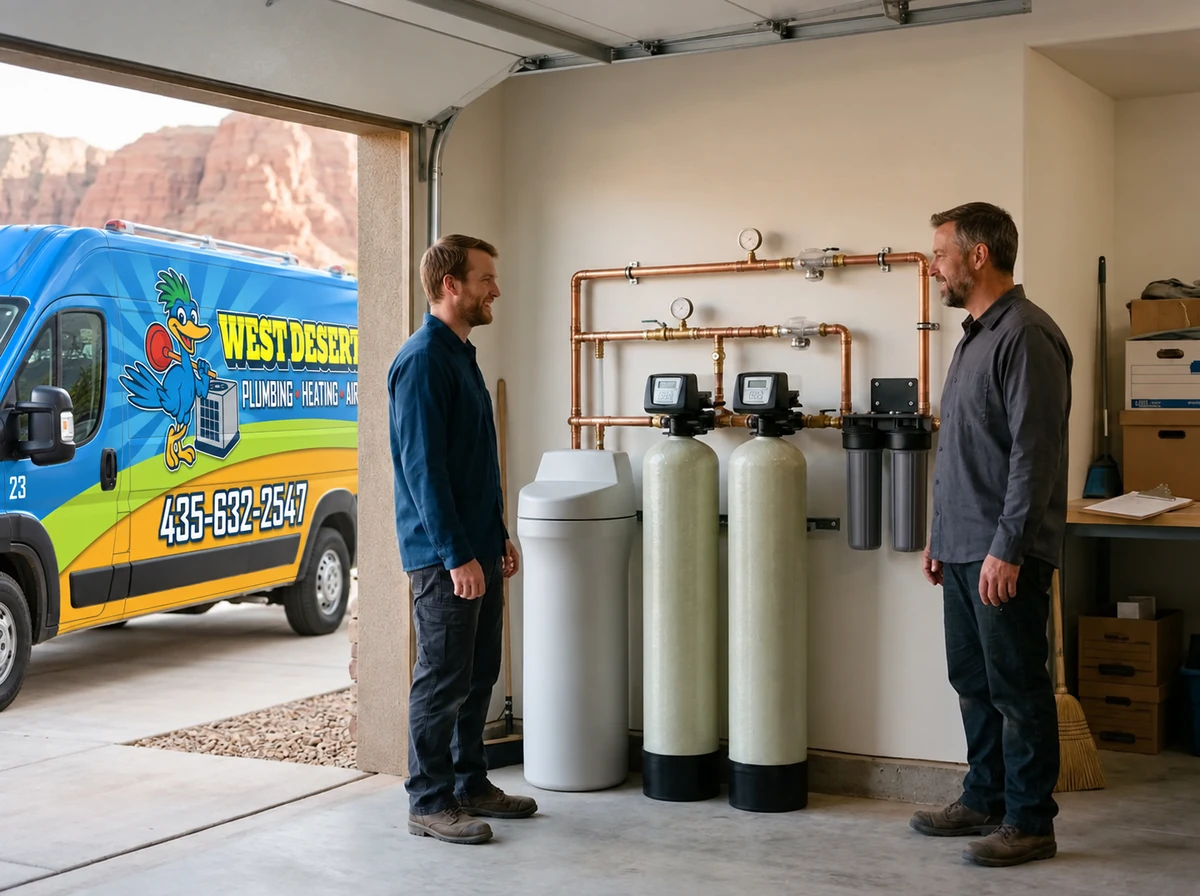
A water softener isn't technically a “filtration” system - it's an ion exchange device that swaps calcium and magnesium ions for sodium ions, eliminating hardness throughout your entire home. Every tap, every shower, every appliance gets softened water.
2. Whole-Home Sediment and Carbon Filters
Sediment filters capture particles. Activated carbon can reduce certain tastes, odors, and contaminants, depending on the product. Check its certification for the specific reduction claimed.
A whole-home carbon filter pairs well with a water softener - the softener handles hardness while the carbon filter handles taste, odor, and chemical concerns. Combined systems are available and are popular with Southern Utah homeowners who want comprehensive coverage.
Ask for a quote covering equipment, installation, replacement media, and the maintenance interval specified for the model and water conditions.
3. Reverse Osmosis (RO) Systems
Reverse osmosis uses a membrane to reduce dissolved substances. Performance is contaminant- and model-specific, so check certified reduction claims and maintenance requirements. An RO system does not automatically make any water source safe.
The catch: RO systems are point-of-use devices, meaning they typically serve a single tap (usually the kitchen sink) rather than the whole house. They're also slower - an RO system produces filtered water gradually and stores it in a small tank under the sink. Most families find the output plenty sufficient for drinking and cooking.
Because they work best on already-softened water (hard water clogs RO membranes faster), pairing an RO system with a whole-home water softener is a common and effective combination for St. George homes.
4. UV Purification Systems
UV systems can inactivate microorganisms under the right treatment conditions. They do not remove dissolved minerals or chemicals; equipment selection, pretreatment, flow, and maintenance matter.
During a boil-water or other drinking-water advisory, follow the water provider's and health authority's instructions even if the home has a filter or UV system. Household treatment does not automatically override an advisory.
5. Activated Carbon Pitcher and Faucet Filters
Products like Brita and PUR pitchers and faucet filters are widely available, inexpensive, and effective at improving taste and reducing chlorine at the point of use. For renters, those on tight budgets, or homeowners who just want better-tasting drinking water without a full installation, these work well as a starting point.
The limitation is scope - they don't address hardness, they don't protect your appliances, and filter replacement costs add up over time. For homeowners serious about long-term water quality and home protection, they're a short-term fix rather than a complete solution.
How to Match the Right System to Your Home
The best water filtration system depends on what problem you're actually trying to solve. Here's a simple framework:
- Hard water causing scale buildup and appliance wear? Start with a whole-home water softener. It's the most impactful single investment for Southern Utah homes.
- Chlorine taste and odor from the tap? Add a whole-home carbon filter or at minimum a point-of-use carbon filter at the kitchen sink.
- Want the purest possible drinking water? Add an under-sink reverse osmosis system to your kitchen tap.
- On a private well or concerned about microorganisms? Obtain appropriate testing and treatment guidance for the result.
- Considering combined treatment? Match each stage to a measured concern and confirm how the stages work together.
Installation and Maintenance: What to Expect
Installation requirements vary by system, access, existing plumbing, drainage, and electrical needs. Confirm the work scope and expected water interruption with the installer before scheduling.
Ongoing maintenance varies by system:
- Water softeners need salt and routine checks based on household use and the model's instructions.
- Carbon filters need media or cartridge replacement based on their rated capacity and instructions.
- RO systems need filter and membrane service on the manufacturer's schedule, adjusted for measured performance.
- UV systems require lamp, sleeve, and monitoring maintenance according to the manufacturer.
A licensed plumber can set you up with a maintenance schedule so you never miss a replacement - and many systems now include smart monitors that alert you when it's time to service them.
Is a Water Filtration System Worth It in St. George?
Compare the tested concern with the equipment, installation, water use, replacement media, and maintenance costs. Avoid assuming that every household needs the same combination or will recover its cost through energy savings.
The value depends on whether the treatment solves the measured problem and whether the household can maintain it as directed.
Ready to Improve Your Home's Water Quality? Call West Desert Plumbing, Heating & Air
West Desert Plumbing, Heating & Air has been helping St. George homeowners tackle Southern Utah's challenging water quality with professional water softener and filtration installations. Our licensed plumbers can test your water, walk you through your options, and install a system tailored to your home's specific needs - whether that's a standalone softener, a whole-home filtration setup, or a complete RO drinking water system.
We serve St. George, Washington, Ivins, Hurricane, Santa Clara, La Verkin, and the surrounding communities throughout Washington County. Call to discuss a water quality consultation and confirm its scope and any charge and find out exactly what's in your water - and how to fix it.
Before a service visit
Four details that improve the diagnosis.
- Exact concern the system must address
- Current utility report or property test
- Third-party certification for the stated reduction
- Filter schedule, flow, drain, and storage needs
Sources and review
Authoritative references.
This resource was updated on . The references below support the safety and maintenance framework used on this page.
- Home drinking water filtration fact sheet (opens in a new tab)U.S. Environmental Protection Agency
- Washington County water quality and source information (opens in a new tab)Washington County Water Conservancy District