
Quick answer
What matters most.
Hard water leaves calcium scale that clogs aerators and valves and builds up inside water heaters, most heavily on the hot side. Softening, conditioning, descaling, and part replacement address different stages of the problem.
Homeowner guide
The full guide.
The shower head sprays sideways. The kitchen faucet pushes out half the water it used to. There is a white crust on the spout you cannot scrub off. That is hard water buildup, and in this corner of Utah it is not a maintenance failure on your part. It is chemistry doing exactly what it does here.
Water that moves through limestone, dolomite, and gypsum picks up dissolved calcium and magnesium. Those minerals stay in solution while the water is cold and under pressure. Change either condition and they come out of solution as a solid. That solid is scale, and it lands inside your pipes, valves, and fixtures.
Here is the mechanism behind hard water buildup, where it does the most damage in a home, and what actually slows it down.
What Makes Water “Hard” in the First Place
Hardness is a measure of dissolved calcium and magnesium, and it is the raw material for every bit of hard water buildup in your house. Rainwater picks up carbon dioxide, turns mildly acidic, and dissolves the carbonate rock it passes through on its way to an aquifer. Southern Utah geology is full of that rock.
The U.S. Geological Survey's water hardness overview (opens in a new tab) explains the hardness classification scale and notes that hard water is widespread across the western United States. The EPA treats hardness as an aesthetic and nuisance issue rather than a health-based contaminant, and it publishes more in its ground water and drinking water section (opens in a new tab).
The Mechanism: Why Calcium Leaves the Water
Most dissolved solids get more soluble as water warms. Calcium carbonate does the opposite. It is less soluble in hot water than in cold, which is why the hot side of a home always scales first.
Three triggers drive hard water buildup in a house:
- Heat. Inside a water heater, dissolved calcium carbonate drops out of solution and bonds to the hottest surfaces it can find.
- Pressure drop and turbulence. Where water leaves a small orifice, carbon dioxide escapes solution, the pH rises, and calcium precipitates right at that point. Aerator screens and shower head jets are textbook locations.
- Evaporation. Water sitting on a surface evaporates and leaves behind every mineral it carried, which is the film on glass doors and faucet bases.
None of that requires neglect. It runs on a schedule set by your water, your temperature settings, and how much water your household uses.
Where Hard Water Buildup Does Real Damage
A crusty faucet is cosmetic. These are not:
- Water heaters. Scale settles on the tank bottom above a gas burner, or bakes onto electric elements as a shell. Either way it insulates the heat source from the water, so the burner or element runs longer and hotter.
- Faucet cartridges and valve seats. One grain of scale on a sealing surface keeps a valve from closing fully, which is why drips start after years of no trouble.
- Toilet fill valves and rim jets. Deposits close off the small rim holes and weaken the flush.
- Angle stops under sinks. Scale seizes the stem, so the shutoff you count on in an emergency will not turn.
- Appliance inlet valves. Dishwasher and washer solenoid valves are tight-tolerance parts and do not tolerate grit.
Tankless units deserve their own mention. Their heat exchanger passages are narrow and water reaches high temperature fast, so scale builds quickly without a descaling routine. That is why maintenance comes up any time we discuss water heaters with a homeowner here.
A Scenario You Might Recognize
Picture a St. George home in Little Valley where the master shower has lost pressure. Everything else in the house seems fine.
In a case like this, a technician who pulls the shower head might find a third of its jets plugged and a chalky ring inside the fitting. The mixing valve cartridge could carry scale on the hot inlet port and almost none on the cold. Pressure at the outdoor hose bibb would likely read normal.
That contrast would be the diagnosis. Supply pressure is not the problem. The hot side has been heating, cooling, and reheating for years, dropping calcium at every restriction, until the hard water buildup finally closes off enough area to notice in a single shower.
What Actually Slows Hard Water Buildup
Scrubbing does not make hard water soft. You either remove the minerals, change how they behave, or stay ahead of the deposits:
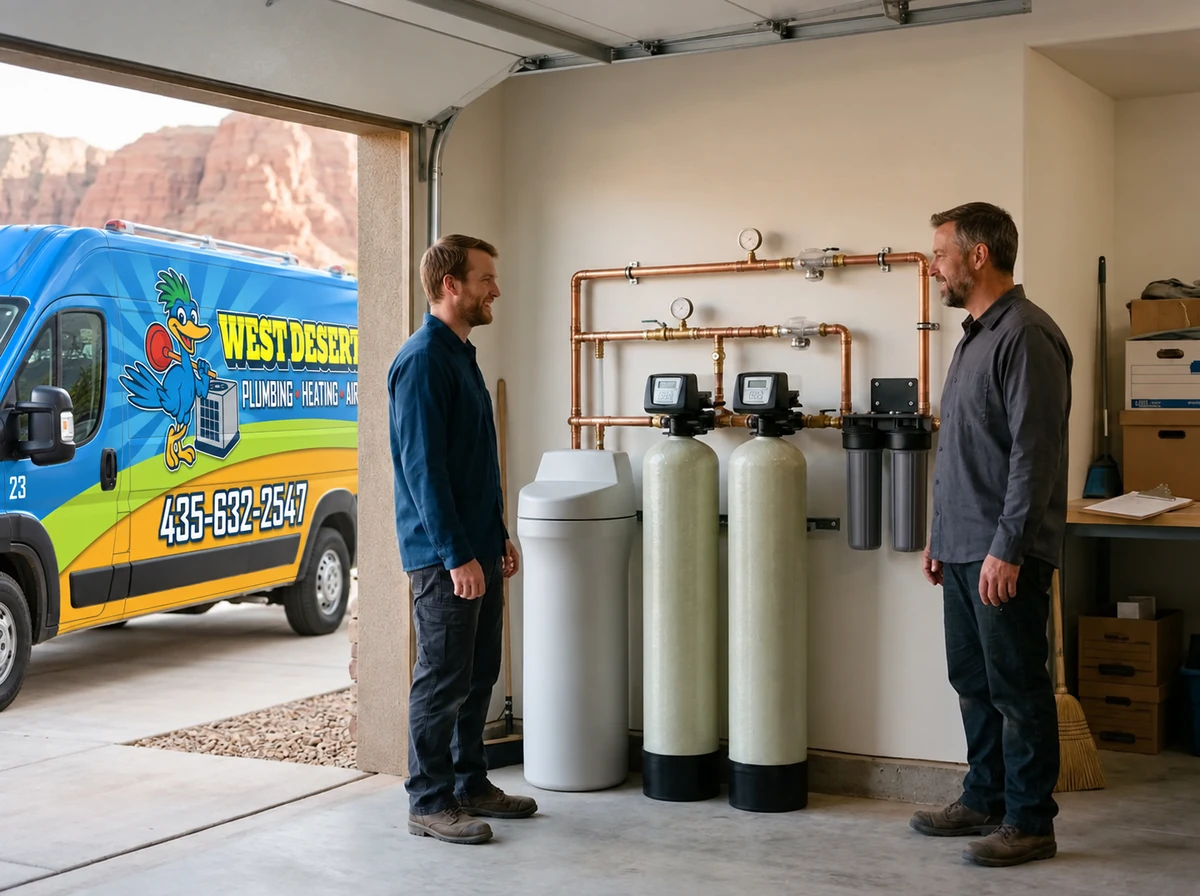
- Ion exchange softeners swap calcium and magnesium for sodium or potassium on a resin bed, then flush that resin with brine on a cycle. This is the only common whole-house approach that removes hardness minerals.
- Template-assisted crystallization conditioners remove nothing. They are marketed as converting dissolved calcium into microscopic crystals that stay suspended and are less likely to stick to hot surfaces, and independent results vary, so ask for performance data before choosing one.
- Descaling and flushing clears what has already formed. Tank heaters get flushed, tankless units get circulated with a descaling solution, and aerators and shower heads get soaked in vinegar.
- Fixture service replaces the parts scale has already ruined, usually cartridges, seats, and supply stops.
Softeners and conditioners solve different problems, so the right answer depends on your water, your household, and what has already failed. Our water softener page lays out how the two approaches differ, and the EPA's WaterSense program (opens in a new tab) is a good reference on the efficiency side of fixture choices.
Safety and When to Call a Plumber
Soaking an aerator in vinegar is a fine weekend job. A few things are not:
- Skip strong acid descalers on chrome and brushed finishes, and never mix cleaning chemicals.
- Do not flush a gas or electric water heater unless you know how to isolate power or gas first.
- Do not force a seized angle stop. The stem snaps, and then you have an open supply line under a cabinet.
Call a plumber when fixtures drip after a cartridge change, when the water heater rumbles or takes longer to recover, when a shutoff will not turn, or when hard water buildup has cut flow across the whole house instead of at one fixture. House-wide flow loss can mean scale inside the piping itself, which is a different conversation. Our team handles that alongside routine faucet and fixture repair.
Frequently Asked Questions
Is hard water safe to drink?
The EPA regulates hardness as a secondary, aesthetic standard rather than a health-based one. If you have a specific health concern about your water, raise it with your physician or your water provider instead of acting on general advice.
Will a water softener remove scale that is already there?
Not directly. Softened water stops adding new deposits and will slowly loosen some older buildup, but scale already bonded inside a water heater or a valve needs flushing or part replacement.
Why does the hot water side clog faster?
Calcium carbonate becomes less soluble as temperature rises, so it precipitates fastest on hot surfaces. That is the same reason tank bottoms and heating elements scale before anything on the cold side.
How fast does hard water buildup come back after descaling?
That depends on your hardness level and hot water use. Many St. George homes benefit from soaking aerators and shower heads once or twice a year and flushing the water heater annually. Homes on untreated well water usually need it more often.
Get Ahead of the Scale
Hard water buildup in St. George is predictable, which makes it manageable. Call West Desert Plumbing, Heating & Air to schedule a plumbing visit, and have a technician check your fixtures, flush your water heater, and explain whether softening or conditioning fits your home.
Before a service visit
Four details that improve the diagnosis.
- Which fixtures lost flow, hot side or cold side
- Water heater age and last flush
- Drips after a cartridge change
- Shutoffs that no longer turn
Sources and review
Authoritative references.
This resource was updated on . The references below support the safety and maintenance framework used on this page.
- Hardness of water (opens in a new tab)U.S. Geological Survey
- St. George drinking water quality report (opens in a new tab)City of St. George
- Cation exchange water softeners (opens in a new tab)U.S. Environmental Protection Agency WaterSense