
Quick answer
What matters most.
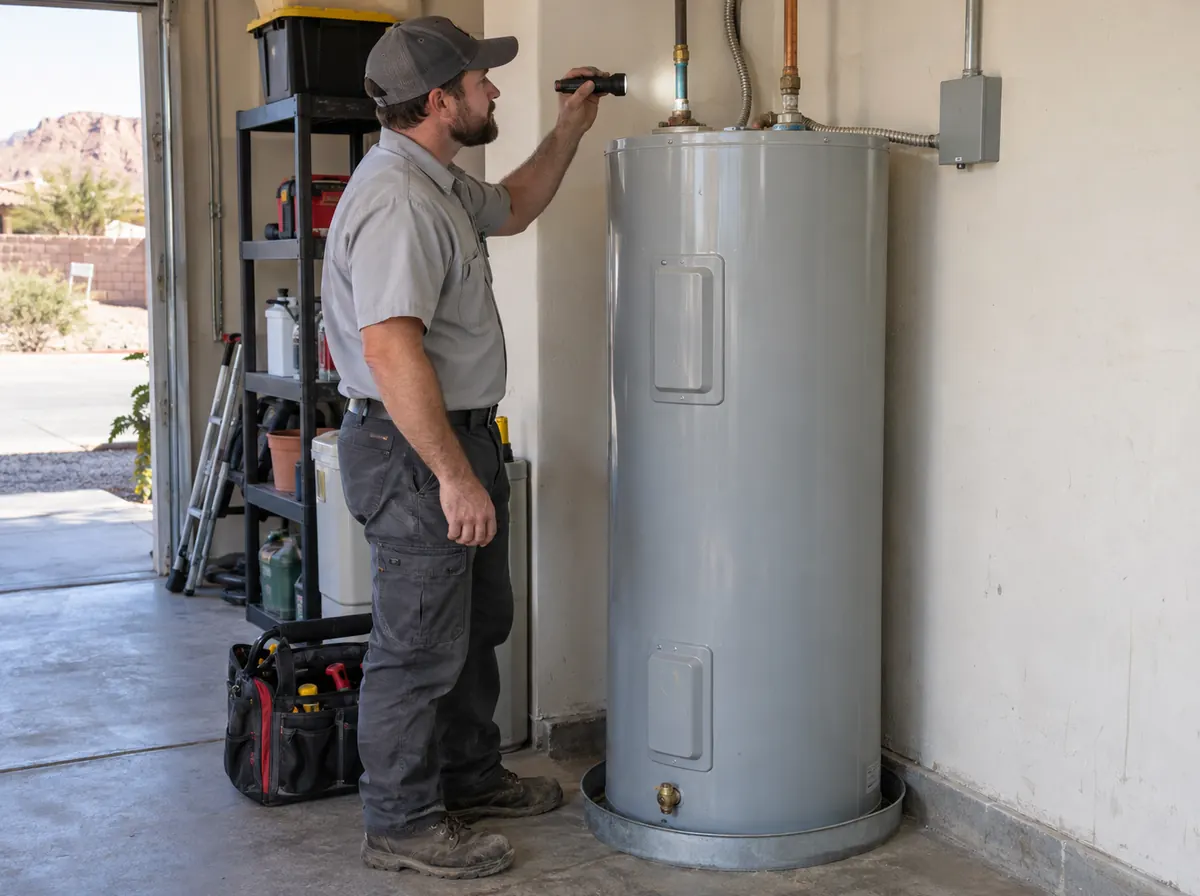
A popping or rumbling water heater is usually steam escaping a layer of sediment on the tank bottom. Flushing helps when the sediment is still loose, while a tank with hardened scale or moisture at the base may need replacement.
Homeowner guide
The full guide.
You hear it from the garage in the morning: a series of pops, knocks, or a low rumble that runs for a minute and then stops. A water heater popping noise is a common complaint in St. George, and it is rarely a tank about to fail catastrophically. It is steam, and there is a specific reason it forms.
The short version behind a water heater popping noise is this. Hard water leaves a layer of mineral sediment on the bottom of your tank, water gets trapped underneath that layer, and the burner superheats the trapped water until it flashes to steam. The bubbles then punch up through the sediment to escape. That is the sound you hear.
Here is the full mechanism, why it matters for the life of the tank, and what to do about it.
Why Sediment Collects in Southern Utah Tanks
Water here carries a heavy load of dissolved calcium and magnesium. Calcium carbonate has a property most dissolved solids do not: it becomes less soluble as water gets hotter. Heat the water and the calcium falls out of solution.
Inside a tank-style heater, that mineral drops to the bottom and builds a crusted layer. The U.S. Geological Survey's hardness of water overview (opens in a new tab) explains how hardness is measured and notes that hard water is widespread across the western United States. The EPA's ground water and drinking water pages (opens in a new tab) cover how hardness is treated compared with health-based contaminants.
The result is a bed of scale sitting directly between a gas burner and the water it is trying to heat.
What Causes a Water Heater Popping Noise
On a gas heater, the flame heats the bottom of the steel tank. Water touching that steel is supposed to circulate freely, absorb heat, and rise.
Sediment breaks that circulation. Pockets of water get trapped between the scale and the tank floor, where the flame drives them past boiling. Those pockets flash to steam, and each bubble forces its way up through the crust. One bubble is a pop. Many at once become a rumble, or something close to a percolating coffee pot.
Electric heaters produce a different version of the same problem. Sediment buries the lower heating element, water around it superheats, and scale on the element cracks and flakes as it cycles.
A water heater popping noise, in other words, is not the tank straining against pressure. It is a boiling sound coming from a place where boiling should not happen.
Why It Matters More Than the Noise Suggests
Sediment insulates. Once a layer forms, the burner has to drive heat through scale instead of into water, and several things follow:
- The steel overheats. The glass lining that protects the steel is not designed for that localized heat, and it can craze and crack.
- Recovery slows. The burner runs longer to reach the setpoint, so hot water runs out sooner than it used to.
- Electric elements burn out. An element buried in sediment cannot shed heat into water and fails early.
- The drain valve clogs. Scale packs the valve, which makes routine flushing harder the longer it is put off.
- Tank life shortens. Overheated steel plus a stressed lining is the usual road to a leaking tank.
A water heater popping noise is the early warning. What it is warning about is the condition of the tank itself.
A Scenario From a Bloomington Garage
Picture a family in Bloomington, just south of St. George, whose hot water runs out during back-to-back showers. The heater has also started rumbling every morning.
Say the unit is about eight years old and has never been flushed. If a technician opens the drain, a likely finding is water that comes out grey and gritty rather than clear, with flow that stops on chunks of scale.
That would be the whole picture. Sediment cuts the tank's usable volume and insulates the burner, so recovery slows and the hot water runs short. The water heater popping noise at 6 a.m. is steam escaping while the burner tries to catch up after the first shower.
Flushing, Descaling, and the Options That Actually Help
The right answer depends on where your heater sits in its life:
- Annual flushing drains sediment before it hardens. On a tank flushed regularly, the job is quick and keeps the bottom clean.
- Descaling a tankless unit is the equivalent task. Tankless heat exchangers have narrow passages and scale fast in this water, so they are circulated with a descaling solution rather than drained.
- Element or anode replacement addresses the parts that fail first. The anode rod is a sacrificial metal rod that corrodes on purpose so the tank does not, and it is worth checking at every service.
- Treating the water slows the whole process at the source. Our water softener page explains how ion exchange and crystallization approaches differ.
- Replacement is the honest answer for a tank with years of hardened sediment, a clogged drain valve, and a noise that returns weeks after a flush.
If your tank has never been flushed and is well into its service life, disturbing the sediment can expose a spot where the lining has already failed. That is worth knowing before you start, and it is a conversation to have about your specific water heater rather than a rule for every tank.
Safety Before You Touch Anything
Flushing is within reach for a handy homeowner, but the hazards are real:
- The water inside is hot enough to cause serious scald burns instantly.
- Gas heaters need the control valve set correctly before and after, and the burner area is not a place to improvise.
- The temperature and pressure relief valve is a safety device. Never cap it, plug it, or tie it off, and call a plumber if it drips or discharges.
- Electric heaters must be shut off at the breaker before draining, because an element energized in an empty tank burns out in seconds.
If you smell gas near the appliance, leave the building and call your gas utility first.
When to Call a Professional
Call us when a water heater popping noise returns soon after a flush, when hot water runs out sooner than it used to, when the drain valve will not open or close, when you see rust-colored water, or when there is moisture around the base of the tank.
Water at the base usually means the tank itself has failed, and that does not get repaired. Our plumbing services cover both diagnosis and replacement. ENERGY STAR's pages on tankless (opens in a new tab) and gas storage (opens in a new tab) models help when you are comparing tank and tankless equipment.
Frequently Asked Questions
Is a water heater popping noise dangerous?
The sound itself is steam escaping sediment rather than a pressure problem, and the relief valve exists to handle genuine overpressure. It still signals scale that is shortening tank life, so it should not be ignored.
Will flushing the tank stop the noise?
Often, if the sediment is still loose. On tanks that have gone years without service, the scale hardens into a crust a standard flush will not lift, and the sound returns quickly.
How often should a water heater be flushed here?
Annually is the working rule in this valley because of how hard the water is. Homes with a softener can usually stretch that interval, and homes on untreated well water may need it more often.
Do tankless water heaters make the same noise?
Not the popping, since there is no tank holding sediment. They scale inside the heat exchanger instead, which shows up as reduced flow, temperature swings, or an error code rather than a sound.
Get the Tank Checked Before It Leaks
A water heater popping noise is your tank telling you what is sitting on its floor. Call West Desert Plumbing, Heating & Air to schedule a water heater service visit in St. George, and have a technician flush the tank, inspect the anode rod, and tell you plainly how much life is left in it.
Before a service visit
Four details that improve the diagnosis.
- Age of the water heater and last flush
- How the noise changes after a flush
- Hot water running out sooner
- Moisture or rust at the base of the tank
Sources and review
Authoritative references.
This resource was updated on . The references below support the safety and maintenance framework used on this page.
- Water heating guidance (opens in a new tab)U.S. Department of Energy
- Hardness of water (opens in a new tab)U.S. Geological Survey
- St. George drinking water quality report (opens in a new tab)City of St. George