Quick answer
What matters most.
A dirty condenser coil blocks heat rejection, which raises pressure and cuts cooling. Cleaning belongs inside-out with the power off, a pressure washer should never be used, and a system that still falls behind needs a technician.
Homeowner guide
The full guide.
Your AC runs nearly nonstop in August, the house never quite reaches the setting, and the outdoor unit feels hot enough to bake on. Before anyone talks about refrigerant or compressors, we look at the coil. A dirty condenser coil is an often-overlooked reason a cooling system loses capacity in St. George, and it is among the easier ones to fix.
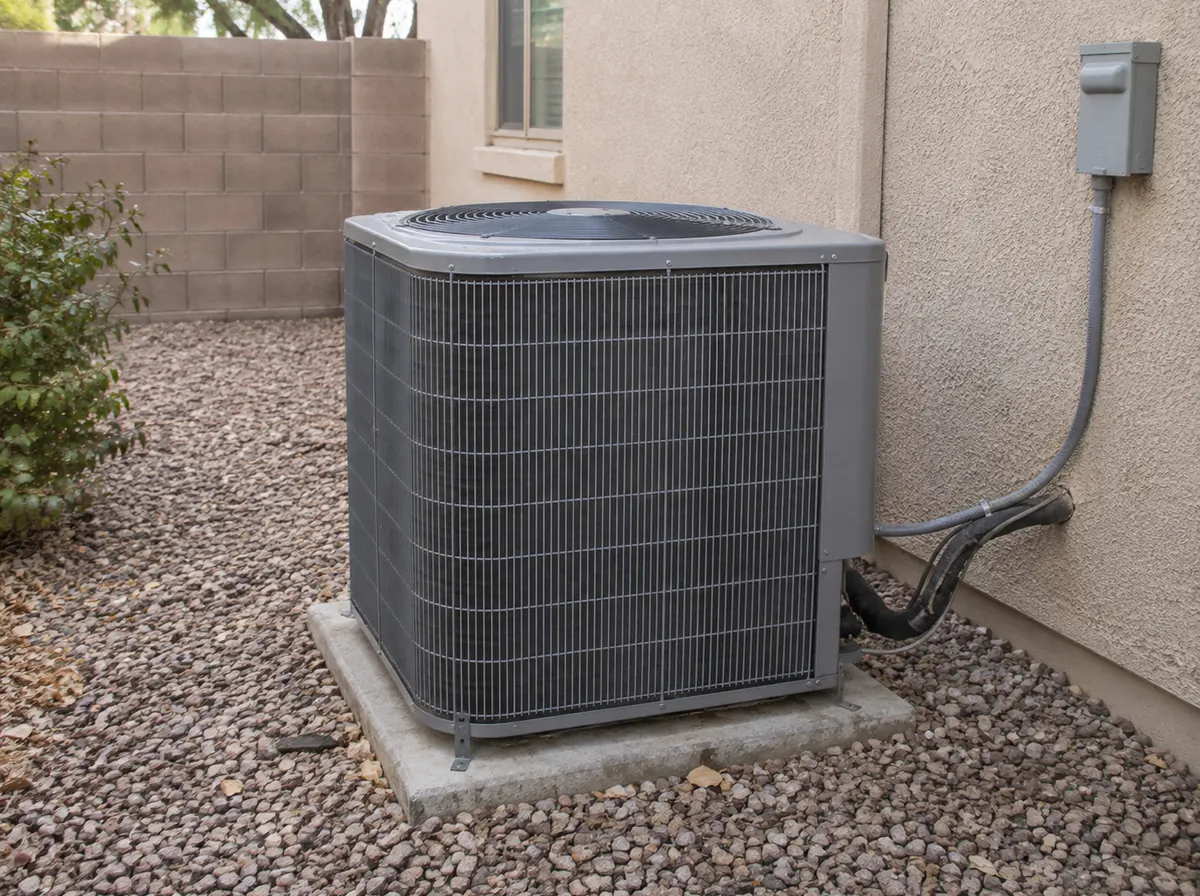
The condenser is the outdoor half of your system. Hot, high-pressure refrigerant gas arrives there carrying every bit of heat pulled out of your house, and it has to give that heat up to the outdoor air before it can cycle back inside. That handoff happens entirely across thin aluminum fins.
Block those fins and the handoff fails. Here is exactly what a dirty condenser coil does to the machine.
How the Condenser Rejects Heat
Refrigerant leaves the compressor as a hot gas. As it travels through the condenser tubing, heat conducts into the fins, and the fan pulls outside air across those fins to carry the heat away. Giving up that heat is what turns the gas back into a liquid, which is the entire point of the condenser.
Two things make it work: surface area and airflow. Fins provide the surface area. The fan provides the airflow. Fouling attacks both at once.
What a Dirty Condenser Coil Does to System Pressure
Dust packed into the fin pack acts as insulation and as a physical restriction. Less air moves through, and the heat that does reach the fins transfers more slowly.
The refrigerant then has to get hotter before it can shed heat into the surrounding air, so condensing temperature climbs. Higher condensing temperature means higher head pressure, and that cascades:
- The compressor works against a larger pressure difference, so its current draw rises.
- Discharge temperature climbs, which cooks the compressor's lubricating oil over time.
- Cooling capacity falls, so the system runs longer to remove the same heat.
- Eventually the high-pressure switch or the thermal overload opens and shuts the unit down mid-afternoon.
That last symptom is why so many August calls describe an AC that “works in the morning and quits by four.” Nothing broke at four o'clock. The system simply crossed a limit it had been approaching all summer.
Heat rejection is also why equipment sizing and airflow specifications exist in the first place, and organizations like ASHRAE (opens in a new tab) publish the engineering standards behind those design points.
Why Southern Utah Fouls Coils Faster
The coil in a Midwest backyard sees grass clippings and pollen. Here, it sees a different diet:
- Fine red silt that blows in with summer monsoon storms and packs deep into the fin pack rather than sitting on the surface.
- Construction dust from the constant building activity around Washington, Hurricane, and the growing east side of the valley.
- Cottonwood and poplar fluff in early summer, which mats across the coil face like felt.
- Dryer vents and landscape debris near the equipment pad, since installers often place units on the side yard where the dryer terminates.
- Hard water spray from sprinklers hitting the coil, which leaves mineral deposits that dust then sticks to.
Sprinkler overspray is the one homeowners never expect. Mineral-laden water evaporates on hot aluminum and leaves a scale film, and that film grabs silt like tape.
A Scenario You Might Recognize
Picture a home in Coral Canyon where the upstairs will not get below 80. The system was fine in June. The filter is new, the vents are open, and the outdoor fan is spinning normally.
In a case like this, the fin surface at the unit would likely look dark grey rather than aluminum. From the inside of the coil, daylight might show through only part of the pack. Refrigerant pressure readings would run high on the discharge side, with the compressor pulling current near the top of its range.
That pattern points to airflow rather than charge. The unit may not be low on refrigerant at all. It is suffocating, and a dirty condenser coil can do that slowly enough that nobody notices until peak load. A proper cleaning from the inside out is the step aimed at bringing pressures back into range.
Cleaning a Dirty Condenser Coil the Right Way
Rinsing a coil from the outside is the most common mistake we see. Air enters the coil from outside and exits toward the fan, so debris embeds facing outward. Spraying from outside drives it deeper.
Done correctly, the job looks like this:
- Power off at the outdoor disconnect and the breaker.
- Remove the top panel and fan assembly so the coil can be rinsed from the inside out.
- Apply a coil cleaner rated for the coil type, then rinse gently with low water pressure.
- Straighten bent fins with a fin comb and clear debris from the base pan.
Safety matters here. Never use a pressure washer on a coil, because the fins flatten under far less force than people expect and flattened fins block airflow permanently. Skip household degreasers and bleach as well, since the wrong chemistry pits aluminum. And never open the electrical compartment, where the capacitor holds a charge even with the power off.
Microchannel coils, common on newer high-efficiency equipment, are all-aluminum and less forgiving than traditional tube-and-fin coils. They need specific cleaners and lower pressure. If you are not sure which kind you have, that is a good reason to have it handled during a scheduled AC tune-up.
Keeping the Coil Clean Between Visits
You can do a lot without opening the cabinet:
- Keep at least a couple of feet of clear space on every side of the unit.
- Trim shrubs and pull weeds growing into the base.
- Aim sprinkler heads away from the equipment.
- Rinse the outside of the fins gently with a garden hose after a dust storm.
- Make sure the dryer vent does not discharge toward the condenser.
For seasonal maintenance context, ENERGY STAR's maintenance checklist (opens in a new tab) lists cleaning the condenser coil as a routine cooling task, and its heating and cooling guidance (opens in a new tab) covers the rest of system efficiency.
When to Call a Professional
Call us when the system runs continuously and still falls behind, when it shuts down on hot afternoons and restarts later, when the outdoor unit is noticeably louder than it used to be, or when you can no longer see light through the coil.
Those are signs the system is operating outside its design range. Book air conditioning repair or ask about our air conditioning services if it has been more than a year since anyone cleaned the coil.
Frequently Asked Questions
How often should a condenser coil be cleaned in St. George?
Once a year is the baseline here, and homes near open desert, active construction, or heavy cottonwood usually need it more. A thorough maintenance visit includes checking coil condition.
Can I clean the coil myself with a garden hose?
You can rinse the outside gently between visits, and that helps. Getting the debris out of the fin pack requires removing the top and fan to rinse from the inside, which is where homeowner attempts usually go wrong.
Does a dirty condenser coil use more electricity?
It makes the compressor work against higher pressure and run longer, so the system draws more energy to deliver the same cooling. That is a physics outcome, not a maintenance opinion.
Will cleaning the coil fix a system that is low on refrigerant?
No. Those are separate problems. A dirty condenser coil and a refrigerant leak can produce similar comfort complaints, which is why a technician measures pressures instead of guessing.
Schedule a Coil Cleaning Before the Next Heat Wave
If your AC is running longer than it used to, call West Desert Plumbing, Heating & Air to schedule a tune-up in St. George. A technician can clean the condenser properly, measure operating pressures, and confirm whether the coil was the whole story.
Before a service visit
Four details that improve the diagnosis.
- Whether light shows through the coil
- Clearance around the outdoor unit
- Sprinkler spray reaching the fins
- Afternoon shutdowns that restart later
Sources and review
Authoritative references.
This resource was updated on . The references below support the safety and maintenance framework used on this page.
- Heating and cooling maintenance checklist (opens in a new tab)ENERGY STAR
- Heating and cooling guidance (opens in a new tab)ENERGY STAR
- WaterSense home maintenance guidance (opens in a new tab)U.S. Environmental Protection Agency