Quick answer
What matters most.
An AC blowing warm air is usually still running but no longer moving heat. Common causes are low refrigerant from a leak, a weak capacitor, or a dirty condenser coil. Check the thermostat, filter, and breaker first, then call for service.
Homeowner guide
The full guide.
You set the thermostat to 74, the system runs all afternoon, and the house keeps getting warmer. An AC blowing warm air in St. George during July is almost always still running. It has simply stopped moving heat.
That distinction matters, because it narrows the cause to a short list of physical failures. Your air conditioner does not create cold. It moves heat out of your house using refrigerant, a fluid that absorbs heat when it boils into a gas and gives that heat up when it condenses back into a liquid. Break any link in that loop and the blower keeps pushing air through the vents while the temperature of that air barely changes.
Here is what physically causes it, what you can check safely, and when it is time to bring in a technician.
What “Blowing Warm Air” Actually Tells You
Two things have to happen for cool air to reach your rooms. The indoor evaporator coil, the finned coil sitting in your air handler, has to get cold enough to pull heat out of the air passing over it. The outdoor condenser coil has to dump that heat into the outside air.
If the blower still moves air but the evaporator coil never gets cold, supply air arrives at close to room temperature. If the outdoor unit quits while the indoor fan keeps running, you get the same result. Sometimes the air is even warmer than the room, because the blower motor adds its own heat to the stream.
Low Refrigerant Charge and What Superheat Reveals
The first thing we check on a system blowing warm air is refrigerant charge, and we read it through superheat.
Superheat is the gap between the temperature of the refrigerant gas leaving the evaporator coil and the temperature at which that refrigerant boiled. When a system loses refrigerant through a leak, less liquid reaches the coil. The refrigerant finishes boiling early, the last section of coil does no useful cooling, and superheat climbs. A high superheat reading is the fingerprint of an undercharged system.
Refrigerant is not burned like fuel. It circulates in a sealed loop, so a low charge means a leak exists. The usual sources we find:
- Corroded brazed joints on the outdoor unit.
- Copper line sets rubbed through where they pass framing or stucco.
- Failed Schrader valve cores hiding under the service caps.
- Pinhole leaks in the evaporator coil itself, often at the return bends.
Adding refrigerant without locating the leak simply puts the same failure back on your calendar. Federal rules under the EPA's Section 608 refrigerant regulations (opens in a new tab) also govern who may handle refrigerant and how it must be recovered.
Capacitor Failure in Extreme Summer Heat
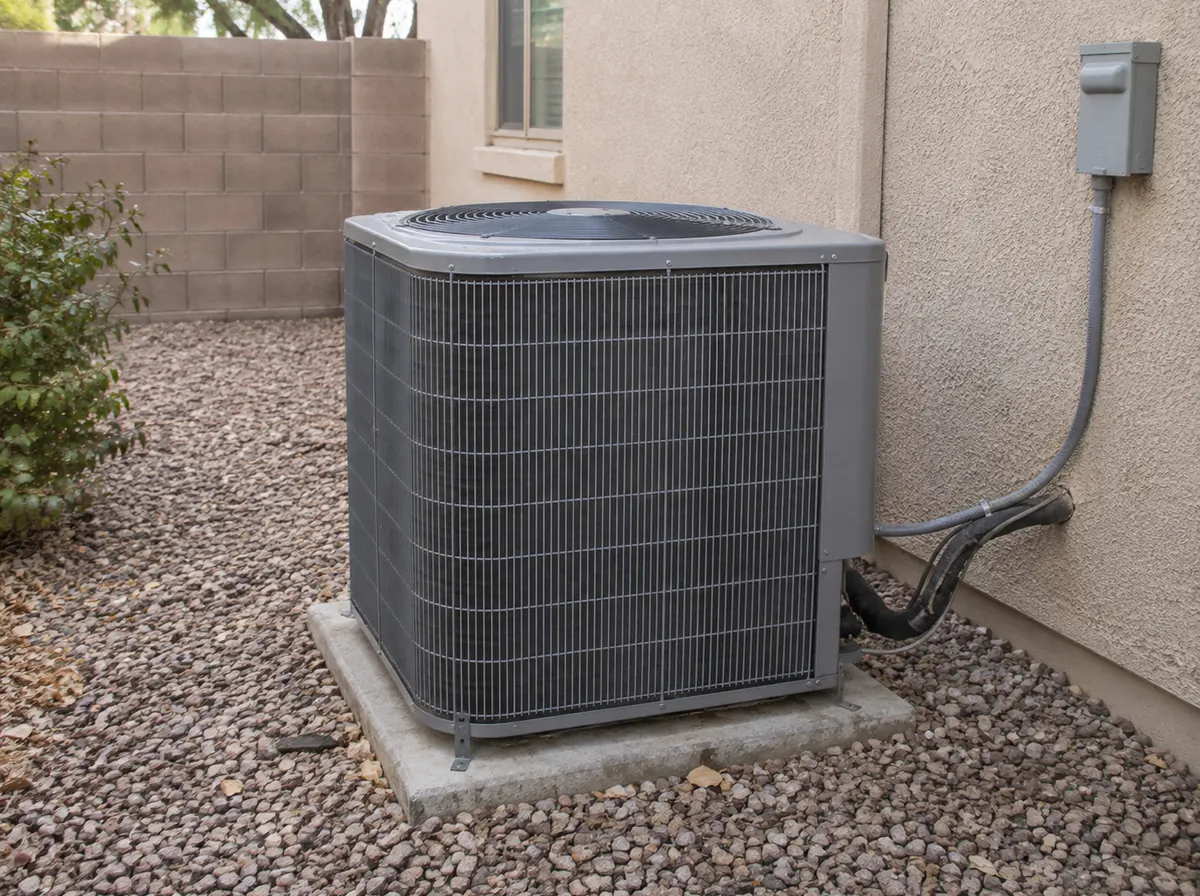
A failed run capacitor is another frequent midsummer cause. The capacitor is the cylindrical component inside the outdoor unit that stores and releases an electrical charge to get the compressor and condenser fan motor turning.
Capacitors hold an electrolyte that dries out with heat and run time. Equipment on a roof or a west-facing pad in St. George sits in the worst condition a capacitor can face: high ambient temperature plus long, repeated cycles.
As the capacitor weakens, the compressor can no longer start against system pressure. You hear a hum or a click at the outdoor unit while the fan blade sits still. The indoor blower has no idea anything is wrong and keeps blowing warm air through every vent in the house.
A capacitor stores a charge even after the power is off, and it can deliver a serious shock with the disconnect pulled. Leave that part to a technician.
Dust, Dirty Condenser Coils, and Southern Utah Air
The outdoor condenser rejects heat only if air can move freely through its fins. Red dust, nearby construction, dryer lint, and grass clippings mat into that fin pack and choke the airflow.
When condenser airflow drops, head pressure rises and the refrigerant cannot fully condense back to a liquid. Cooling capacity falls off first. Then the compressor trips on its high-pressure or thermal overload switch, shuts down, and the supply registers go from cool to blowing warm air within a few minutes.
Coil cleaning is a core part of a seasonal AC tune-up, and in this climate it is the maintenance step that matters most on a July afternoon. ENERGY STAR covers the same ground in its home heating and cooling guidance (opens in a new tab).
A July Scenario You Might Recognize
Picture a hot July workday in a St. George neighborhood like Little Valley or Washington Fields.
Say you leave at 7 a.m. with the thermostat at 78, and the house feels fine. You come home at six to an indoor temperature near 88 and vents blowing warm air. The outdoor unit hums but the fan is not turning. The filter is clean and the indoor blower is strong.
In a case like this, a likely finding is a compressor that tried to restart during the hottest stretch of the afternoon, could not get moving on a weak capacitor, and locked out on thermal overload.
The timing is the giveaway. A system that cools normally in the morning and quits in late afternoon is usually failing under peak load, not failing outright.
What You Can Safely Check First
Before you call, three checks take about two minutes:
- Thermostat mode. Confirm it reads COOL and the fan is set to AUTO, not ON. A fan left on ON blows room-temperature air between cooling cycles, which mimics a real failure.
- Air filter. A loaded filter starves the evaporator coil of airflow and can ice it over, which stops cooling completely.
- Breakers and the outdoor disconnect. Many homes here have a separate breaker for the condenser. If it has tripped, the indoor half keeps running alone.
If you find ice on the copper lines or the indoor coil, shut the system off at the thermostat and leave the fan on AUTO. Running a frozen system can slug liquid refrigerant back to the compressor and turn a repair into a replacement.
When to Call a Professional
Call once you have ruled out the thermostat, the filter, and the breaker. Anything past that point involves sealed refrigerant, high-voltage components, or both.
Book air conditioning repair when the outdoor fan will not spin, when you hear humming or clicking at the condenser, or when the air feels cooler in the morning than in the afternoon. If the house is climbing into the 90s indoors, treat it as urgent and call for emergency AC repair instead of waiting. Heat illness is a real risk in this valley, and Ready.gov publishes extreme heat safety guidance (opens in a new tab) worth reading while you wait.
Frequently Asked Questions
Why is my AC blowing warm air only in the afternoon?
Because the system is failing under load. Higher outdoor temperatures raise head pressure, which makes the compressor harder to start and easier to trip on overload. Weak capacitors, dirty condenser coils, and low charge all show up first during peak heat.
Can I add refrigerant to my AC myself?
No. Refrigerant is sold and handled under EPA rules, and adding it without measuring superheat and subcooling usually makes performance worse. An overcharged system can flood the compressor with liquid.
Does a dirty air filter really stop cooling?
It can. Restricted airflow drops the evaporator coil below freezing, ice forms across the fins, and that ice then blocks airflow completely. Plenty of these calls start with a filter nobody had changed since spring.
Should I shut the system off if the vents are blowing warm air?
Yes, if you see ice, smell anything burning, or hear repeated clicking at the outdoor unit. Running a failing compressor adds damage. If everything looks normal, leaving it off until a technician can look at it is the safer choice.
Schedule Your AC Repair
An air conditioner blowing warm air in St. George is not something to ride out for a week in July. Call West Desert Plumbing, Heating & Air to schedule an air conditioning repair visit, and have a technician measure superheat, test the capacitor, and check the condenser before the heat gets worse.
Before a service visit
Four details that improve the diagnosis.
- Thermostat mode and fan setting
- Filter condition and any ice on the lines
- Whether the outdoor fan is spinning
- Time of day the cooling drops off
Sources and review
Authoritative references.
This resource was updated on . The references below support the safety and maintenance framework used on this page.
- Section 608 refrigerant management (opens in a new tab)U.S. Environmental Protection Agency
- Heating and cooling guidance (opens in a new tab)ENERGY STAR
- Extreme heat safety (opens in a new tab)Ready.gov