
Quick answer
What matters most.
A humming outdoor unit with a stalled fan usually points to a failed run capacitor. Capacitors hold a charge after the power is off, so testing and replacement belong to a technician.
Homeowner guide
The full guide.
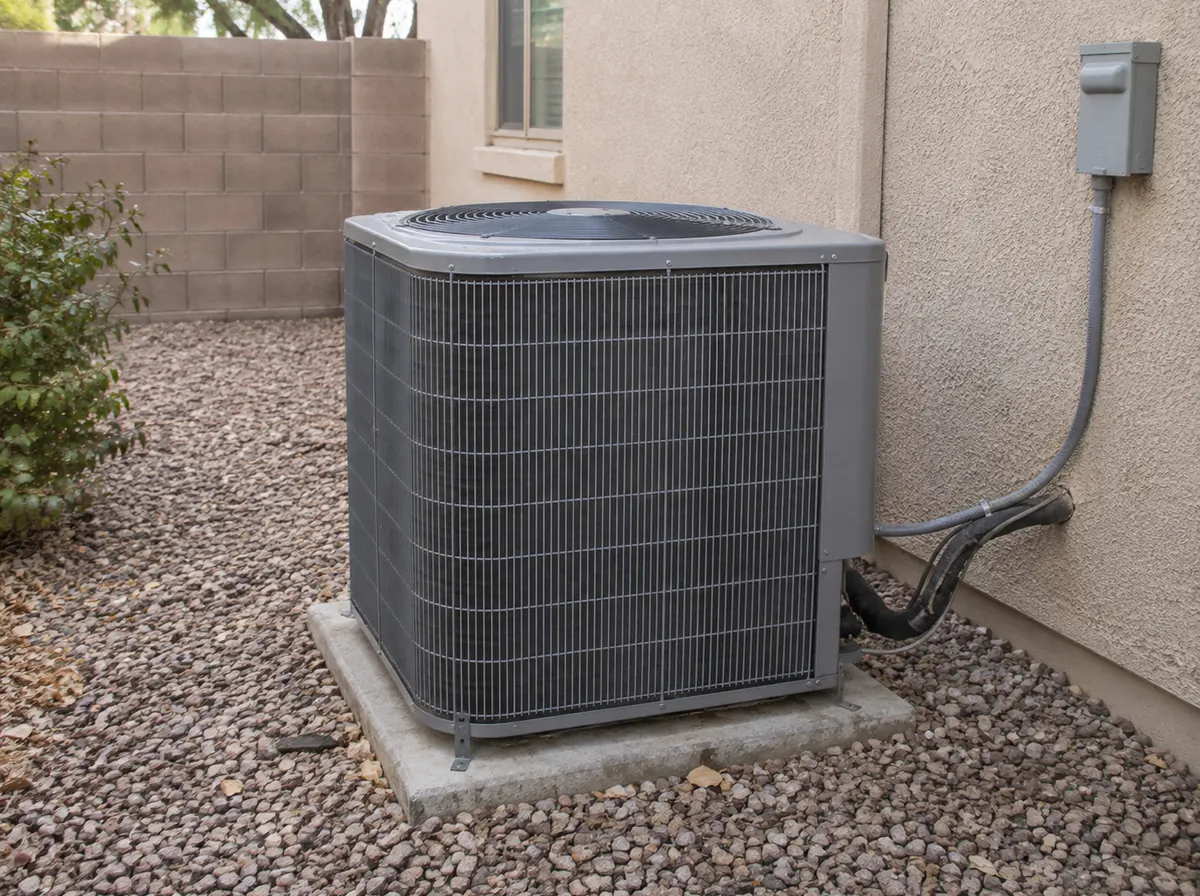
Your outdoor unit hums but the fan sits still. The house gets warmer by the hour. That pattern in July is usually capacitor failure, and it is one of the more common cooling breakdowns in St. George.
A capacitor is a small cylindrical can bolted inside the electrical compartment of your condenser. It is not exotic, and it is not the compressor. It is a charge storage device that gives your motors the electrical kick they need to start turning. When it weakens, the motors cannot start, and everything downstream of them stops working.
Here is what a capacitor actually does, why heat kills it, how to recognize capacitor failure from your patio, and why the repair belongs to a technician.
What the Capacitor Does Inside Your AC
Single-phase power, the kind your home has, does not naturally produce a rotating magnetic field. Motors need one to start turning and to keep turning efficiently. The capacitor creates it.
Inside the can are layers of metal foil separated by a thin dielectric film and soaked in an electrolyte. That construction stores charge and shifts the timing of the current fed to the motor's start winding. The shifted phase makes the magnetic field rotate, and the rotor follows it.
Most residential units use a dual run capacitor, with one section serving the compressor and another serving the condenser fan. That is why capacitor failure can take out the fan, the compressor, or both, depending on which section drops out of specification.
Why Capacitor Failure Is So Common in Desert Heat
Capacitors age on a curve driven by temperature and run time, and both are stacked against equipment in St. George.
The electrolyte inside slowly evaporates and the dielectric film degrades. As that happens, capacitance falls below the microfarad value printed on the label. A motor fed by a weak capacitor draws higher current, takes longer to reach speed, and runs hotter, which heats the capacitor further. That loop feeds itself.
Three local conditions speed it up:
- High ambient temperature. Rooftop units and west-facing equipment pads sit in direct sun all afternoon, and the electrical compartment runs hotter than the outside air.
- Long run cycles. In peak summer, systems here run for hours at a stretch instead of cycling off, so the capacitor never gets a cool-down period.
- Voltage swings. Brownouts and surges during heavy grid demand stress the dielectric.
When capacitance falls far enough, the compressor can no longer overcome system pressure at startup. It draws locked rotor current, heats up, and trips its internal thermal overload. You get a hum, a click, and silence.
Symptoms of Capacitor Failure You Can Spot Safely
You do not need tools to notice most of these:
- A humming outdoor unit with a fan blade that will not turn.
- A fan that starts only after someone nudges the blade, the classic sign of a weak run capacitor. Do not try this yourself.
- Clicking at the contactor every few minutes as the unit tries and fails to start.
- Indoor air barely cooler than the room, because the indoor blower keeps running regardless.
- A breaker that trips repeatedly on hot afternoons.
- A capacitor with a domed or bulging top, visible only with a panel off, which signals internal pressure from a breaking-down dielectric.
The symptom we most want homeowners to take seriously is repeated breaker tripping. That means something is drawing current it should not.
A Scenario From a Typical July Afternoon
Picture a homeowner in the Washington Fields area at 4 p.m. The thermostat says 79 and climbing, set to 74. From the back patio they can hear the condenser humming, but the fan on top is motionless. Twenty minutes later the hum stops on its own, then starts again.
In a case like this, a likely finding at the unit is a dual run capacitor reading well under its labeled microfarad value on the fan side. The compressor section may still measure in range, which would explain why the compressor keeps trying to start.
The fan side would give out first here because the fan motor sits directly above the hot condenser coil, pulling heated air past itself all day. Left alone another week, the compressor could keep running without condenser airflow until it trips on high head pressure. Capacitor failure that starts as a stalled fan often ends as a compressor problem when the system keeps trying.
Why This Is Not a DIY Repair
A capacitor holds a charge after the power is off. Pulling the disconnect does not drain it. Contact across the terminals can deliver a dangerous shock, and this is not a repair to learn from a video.
Technicians discharge a capacitor through a resistor before touching it, then measure actual capacitance with a meter rather than trusting appearances. Plenty of failed capacitors look perfectly normal from the outside.
There is a parts question too. Installing a capacitor with a mismatched microfarad or voltage rating makes the motor run outside its design current. That shortens motor life even when the system appears to work again. Matching the equipment specification matters more than getting something into the socket.
For general electrical safety around home equipment, the Consumer Product Safety Commission (opens in a new tab) is a solid reference. If your home is heating up while you wait for service, Ready.gov's extreme heat guidance (opens in a new tab) is worth reading.
Repair, Replace, or Add a Hard Start Kit
Once a technician confirms capacitor failure, there are usually three paths:
- Replace the capacitor with a matched part. This is the standard repair and restores the designed performance.
- Add a hard start kit. This gives an aging compressor extra starting torque. It is a reasonable assist on an older compressor that struggles to start, not a substitute for a failed capacitor.
- Evaluate the whole system. If the compressor has already run with a stalled fan, or the unit has failed repeatedly, the conversation moves from one part to overall condition.
Measuring capacitance is a common step in a thorough AC tune-up, which is how many of these get caught in spring instead of during a July heat wave.
When to Call a Professional
Call right away if you hear humming with no fan movement, if the breaker trips more than once, if you smell anything burning near the outdoor unit, or if the indoor temperature keeps climbing.
Schedule air conditioning repair for normal-hours service anywhere in the St. George area. If the house is already hot and there are kids, pets, or older adults inside, ask for emergency AC repair rather than waiting.
Frequently Asked Questions
How long does an AC capacitor usually last?
Manufacturers specify capacitor life in operating hours at a given temperature rather than in calendar years, so desert equipment reaches end of life sooner than the same unit in a mild climate. We generally see capacitor failure well before a compressor gives out.
Can I spin the fan with a stick to get through the night?
Do not. Technicians use that as a diagnostic with specific precautions, and doing it yourself puts your hand beside a spinning blade and live high-voltage wiring.
Will capacitor failure damage my compressor?
It can. A compressor that repeatedly tries to start against high pressure draws heavy current and overheats. That is why a humming unit is worth shutting off at the thermostat until someone can look at it.
Does regular maintenance prevent this?
Maintenance will not stop a capacitor from aging, but measuring capacitance catches a weak one before it strands you. ENERGY STAR's heating and cooling guidance (opens in a new tab) makes the same case for seasonal service.
Get the Capacitor Tested Before the Next Heat Wave
If your outdoor unit is humming, clicking, or cooling only part of the time, call West Desert Plumbing, Heating & Air to schedule an AC repair visit. A technician can measure the capacitor, verify motor amp draw, and install a replacement matched to your equipment.
Before a service visit
Four details that improve the diagnosis.
- Humming or clicking at the outdoor unit
- Whether the condenser fan is turning
- Breaker that trips on hot afternoons
- How long the indoor air has been warm
Sources and review
Authoritative references.
This resource was updated on . The references below support the safety and maintenance framework used on this page.
- Heating and cooling guidance (opens in a new tab)ENERGY STAR
- Extreme heat safety (opens in a new tab)Ready.gov
- Section 608 refrigerant management (opens in a new tab)U.S. Environmental Protection Agency