
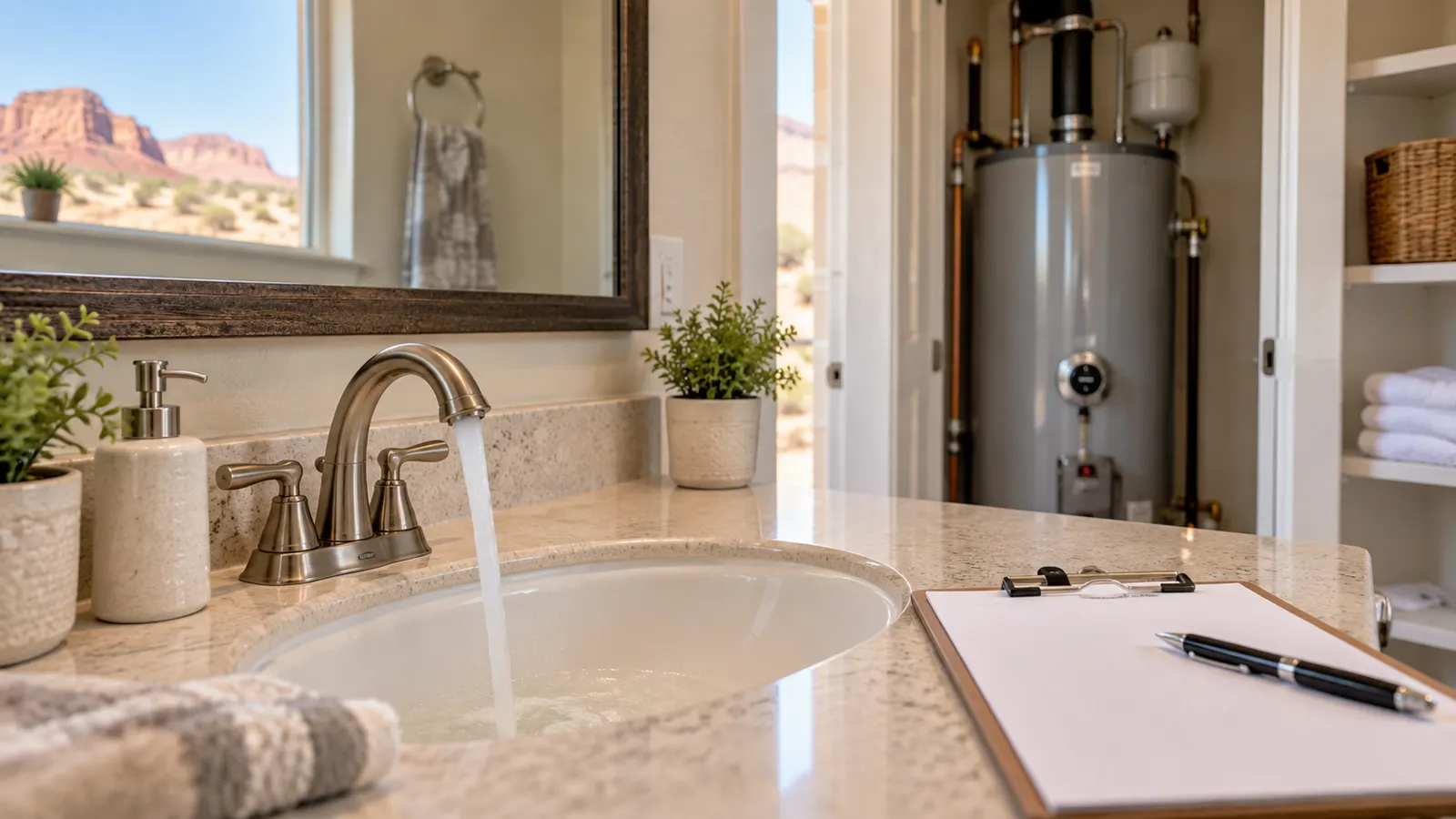
Quick answer
What matters most.
Record whether every fixture has lost hot water, when the change began, any safely visible leak, odor, sound, or error code, and the equipment label details. Do not open panels or attempt gas, electrical, or pressure-related work.
Homeowner guide
The full guide.
Losing hot water is the kind of problem that gets reported in three words and then takes twenty minutes to actually describe. A few notes taken before you pick up the phone change that. Preparing for water heater repair in Washington, Utah is mostly a matter of writing down what you can see, in order, without touching the equipment.
What follows is an observation and preparation routine. It does not diagnose anything, and every step stays on the outside of the system. Water heaters involve stored hot water under pressure along with a fuel supply or a substantial electrical connection, so the work itself belongs to a qualified professional.
Define what "no hot water" means in your house
Start by pinning down the actual condition, because the phrase covers several different situations.
Walk to two or three hot-water fixtures in different parts of the home and run each one for a minute. Write down whether the water is fully cold, briefly warm and then cold, or lukewarm throughout. Note whether the result is the same at every fixture or varies between them.
Check at least one fixture on each floor if your home has more than one. A condition that appears everywhere and a condition limited to one bathroom are different situations, and the distinction is one of the first things a service professional will ask about.
Note when it stopped and what preceded it
Write down when you last had hot water that behaved normally. An approximate answer is fine, and marking it as approximate is better than guessing precisely.
Then record what was happening around that time. Worth noting:
- Whether the loss was sudden or the hot water faded over days
- Heavy hot-water use before it stopped, such as laundry or several showers
- A power interruption in the neighborhood
- Recent plumbing, remodeling, or appliance work in the home
- A period when the house was empty
- Anyone having adjusted a setting or a switch
That last one comes up often and is worth an honest answer. If a control was moved, say so. It is ordinary information, and withholding it only lengthens the visit.
Record what is still working
What continues to function narrows the picture as much as what stopped. Spend a minute on the working parts of the home.
Note whether cold water is normal at the same fixtures, whether water pressure throughout the house seems unchanged, and whether other appliances that use hot water are behaving differently. If you have a water softener, filtration system, or recirculation setup, note that it exists and whether anything about it looks different.
Write down whether the rest of the home has power and whether anything else in the house lost power at the same time. Record that as an observation from the outside. Do not open an electrical panel, reset a breaker, or operate any switch to test a theory.
Look at the equipment area from a safe distance
Go to where the water heater is installed and observe from a normal standing position. Do not move the unit, reach behind it, open a panel, or touch valves, connections, or wiring.
Write down what you can see. Water on the floor or in a drain pan, staining on the floor or a nearby wall, mineral residue on visible piping, or anything dripping from a visible pipe all belong in the notes. Include whether what you see looks active or dried.
Note any sound the unit is making and any odor in the room, described plainly. Also note the surroundings: the amount of clearance around the unit, what is stored nearby, and whether the area is dry.
Two conditions end the routine here. If water is spreading, or if it is anywhere near an outlet, cord, or panel, stay out of the area and report it when you call. If you smell gas, leave the building at once, then call your gas utility and emergency services from outside. Do not return to finish these notes.
Copy the label information you can already read
Water heaters usually carry a data label on the outside of the jacket. If you can read it from where you are standing, without moving anything, copy down the brand, model number, serial number, capacity, and the fuel or power type.
A photograph works as well as transcribing, provided you can take it without squeezing into a tight space or reaching past piping. If the label is hidden, unreadable, or awkward to reach, write "label not visible" and stop. That answer is complete, and the detail gets collected during the visit.
Set aside any paperwork you have as well, including installation records or notes from earlier service. Approximate age is useful even if you have no documents.
What to leave alone while you wait
Everything on the list below requires a qualified professional, and attempting any of it puts a homeowner in contact with fuel, electricity, combustion components, or water held under pressure.
- Do not remove panels, covers, or any part of the jacket
- Do not press a reset button or cycle a breaker
- Do not relight, adjust, or examine any burner or pilot assembly
- Do not open, close, or adjust any valve, including a discharge valve
- Do not drain or flush the tank
- Do not raise the temperature setting to see whether it responds
- Do not touch gas piping, connections, venting, or wiring
If the water supply is actively escaping and you already know where the shutoff for the home is, using it is reasonable. If you do not know, say so when you call rather than searching around the equipment.
Describe it clearly when you call
With notes in hand, the call becomes short. Lead with the condition at the fixtures, then when it started, then what is still working, then what you observed around the unit, then the label information if you have it.
Describe observations rather than conclusions. "Cold at every fixture since yesterday evening, nothing visible on the floor, no sound from the unit" gives a service professional more to work with than a guess about which part is involved.
Mention anything that affects safety at the property first, including standing water, a wet area near electrical components, or an odor. Those details shape how the visit is handled.
Prepare the property for the visit
Clear a path to the equipment and move stored items away from the area. Note where a service vehicle can park, any gate codes, and any animals that will need to be secured. Have your notes and paperwork in one place.
West Desert Plumbing, Heating & Air serves Washington and St. George, Utah, and describes its water heater service on its site. To confirm service availability at your address and schedule a visit, contact West Desert Plumbing, Heating & Air with your notes ready.
Before a service visit
Four details that improve the diagnosis.
- All fixtures or one fixture affected
- Sudden or gradual change
- Visible leak, odor, sound, or code
- Safe equipment and property access
Sources and review
Authoritative references.
This resource was updated on . The references below support the safety and maintenance framework used on this page.
- Water heating guidance (opens in a new tab)U.S. Department of Energy
- St. George drinking water quality report (opens in a new tab)City of St. George