
Quick answer
What matters most.
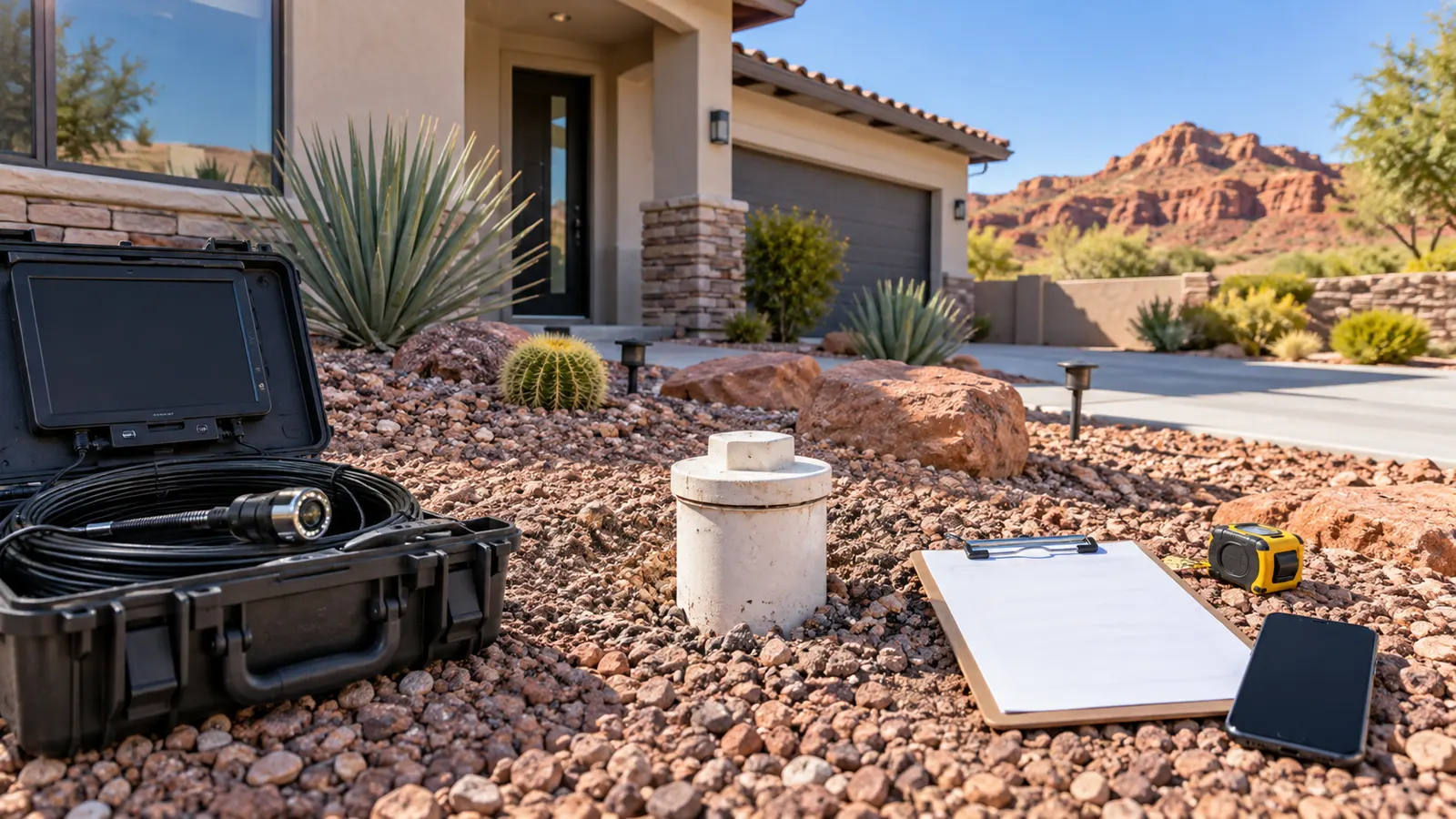
Before a sewer line evaluation, record when the issue started, which fixtures are affected, what repeats across events, what is visible outdoors, and how the property can be accessed. Keep the notes descriptive so the technician can evaluate the cause on site.
Homeowner guide
The full guide.
When a drain backs up for the second time in a month, the useful next step is not a theory about what is happening underground. It is a written record. Preparing for a sewer line evaluation in St. George begins with what you can observe from inside your own home, and the quality of those notes shapes how efficiently a plumbing professional can evaluate the property.
This guide covers five kinds of information worth writing down before anyone arrives: timing, affected fixtures, recurring patterns, exterior observations, and access notes. None of it identifies a cause. A buried line has to be evaluated on site by a qualified professional, and nothing here replaces that evaluation.
Start with timing
Write down when you first noticed the problem. Give a date if you have one, or the week if you do not. Vague memory is still better than nothing, so record your best recollection and mark it as approximate.
Then note the time of day each event happened. Drainage concerns that show up in the morning, after laundry, or during evening use are telling a service professional something about household demand. That context is hard to reconstruct later from memory alone.
Also record whether anything changed in the home before the first event. New occupants, a recent remodel, new landscaping, or a long vacancy are all worth a line in your notes. You are not claiming any of these caused the issue. You are giving the person evaluating your property a timeline to work from.
Name every fixture that behaved differently
A single slow sink and a whole-home backup are different situations, and the difference lives in the fixture list. Walk the house and write down each drain that behaved unusually, including the ones that seemed fine.
For each fixture, note what you saw. Useful entries include:
- Which room and which floor the fixture is on
- Whether water drained slowly, stopped draining, or backed up
- Whether water appeared at a different fixture than the one in use
- Whether a toilet, tub, or floor drain reacted while another fixture ran
- Whether the fixture returned to normal on its own
- Which fixtures showed no change at all
That last item matters more than most homeowners expect. Fixtures that behaved normally help narrow the area under review just as much as the ones that did not.
Record the pattern across repeat events
One event is an incident. Three events with something in common is a pattern, and patterns are what a professional evaluation is built to explain.
Keep a short running log rather than a single summary. Each time the concern returns, add a dated line with the fixtures involved and what the household was doing. Over a few weeks this log answers questions a one-time description cannot, such as whether the interval between events is shrinking or holding steady.
Note whether the condition clears by itself and roughly how long that takes. Also note anything that seems to precede an event, such as heavy laundry use or several showers in a row. Describe the sequence without asserting that one caused the other.
Note what is visible outside, from where you stand
Exterior observations belong in the record, and they should be limited to what you can see from a normal walking position in your own yard. Do not open a cleanout, lift a manhole lid, dig, or reach into any opening.
Things worth writing down include standing water or unusually soft ground along the path between the house and the street, an area of lawn that is noticeably greener or sunken, a new depression in a driveway or walkway, and any odor you notice outdoors near the house. Note where each observation is and when you saw it.
Mature trees and large shrubs near the line's likely path are also worth recording, along with roughly how old they are if you know. Landscaping history in St. George yards is ordinary context for an evaluation, not a conclusion about root intrusion or anything else.
If you know where your exterior cleanout is, write down its location. If you do not, write that down too. Both answers are useful.
Write down how the property can be accessed
Access notes are the least interesting part of the record and the part that most often changes how a visit goes. Sort them out in advance.
Include the following where they apply:
- Where a service vehicle can park and how close it can get to the house
- Gate widths, gate codes, and whether a gate is locked
- Dogs or other animals that will need to be secured
- Whether a crawlspace or basement area is reachable and what is stored in front of it
- Finished surfaces along the likely route, such as pavers, decking, or a poured patio
- Irrigation lines, low-voltage lighting, or other buried utilities you had installed
- HOA rules or shared-driveway arrangements that affect work on the property
- Hours when someone can be home
The buried utility note is worth a few extra minutes. If you have any record of private irrigation or lighting installed after the home was built, set it aside with your other documents.
Keep conclusions out of your notes
The strongest record describes what happened and stops there. Write "the downstairs tub filled while the washing machine drained" rather than "the main line is blocked." The first sentence is an observation anyone can verify. The second is a diagnosis that requires equipment and a site visit.
This restraint is practical, not just cautious. When homeowner notes lead with a conclusion, the details that support or contradict it tend to get trimmed out. Keeping your record descriptive preserves the information a professional actually needs.
For the same reason, avoid deciding in advance what the work should involve. Scope and method are determined after the line has been evaluated, by the professional performing the evaluation, based on conditions at your specific address.
If you want background on how this category of work is approached, West Desert Plumbing, Heating & Air describes its sewer line repair service for St. George properties.
Bring the record to a St. George evaluation
Gather your timeline, fixture list, event log, exterior notes, and access details into one document. A page of plain text is plenty. Bring it to the conversation rather than trying to recall it while someone waits in your driveway.
A good record does two things at once. It shortens the time spent reconstructing history at your property, and it makes the resulting plan easier to follow, because you can check what is proposed against what you actually observed.
When your notes are ready, contact West Desert Plumbing, Heating & Air to schedule an evaluation of your St. George home.
Before a service visit
Four details that improve the diagnosis.
- Date and time of each event
- Affected and unaffected fixtures
- Safe exterior observations
- Cleanout, gate, and parking access
Sources and review
Authoritative references.
This resource was updated on . The references below support the safety and maintenance framework used on this page.
- WaterSense home maintenance guidance (opens in a new tab)U.S. Environmental Protection Agency