
Quick answer
What matters most.
A useful camera review identifies the location, extent, and surrounding pipe condition of a finding. Those details are considered with access, line material, depth, and property constraints before a repair scope is recommended.
Homeowner guide
The full guide.
A camera inspection is often described as the moment a homeowner finally sees the problem. In practice it is the moment a plan becomes possible. Sewer line repair in St. George is scoped from what the camera records, and four findings do most of that work: location, extent, pipe condition, and access.
This article explains how a professional reads those four inputs and turns them into a defined scope. It does not tell you how to run a camera, and it does not describe what your own line contains. Camera work is performed by the plumbing professional evaluating the property, using equipment that requires training to operate and interpret.
What a camera inspection actually produces
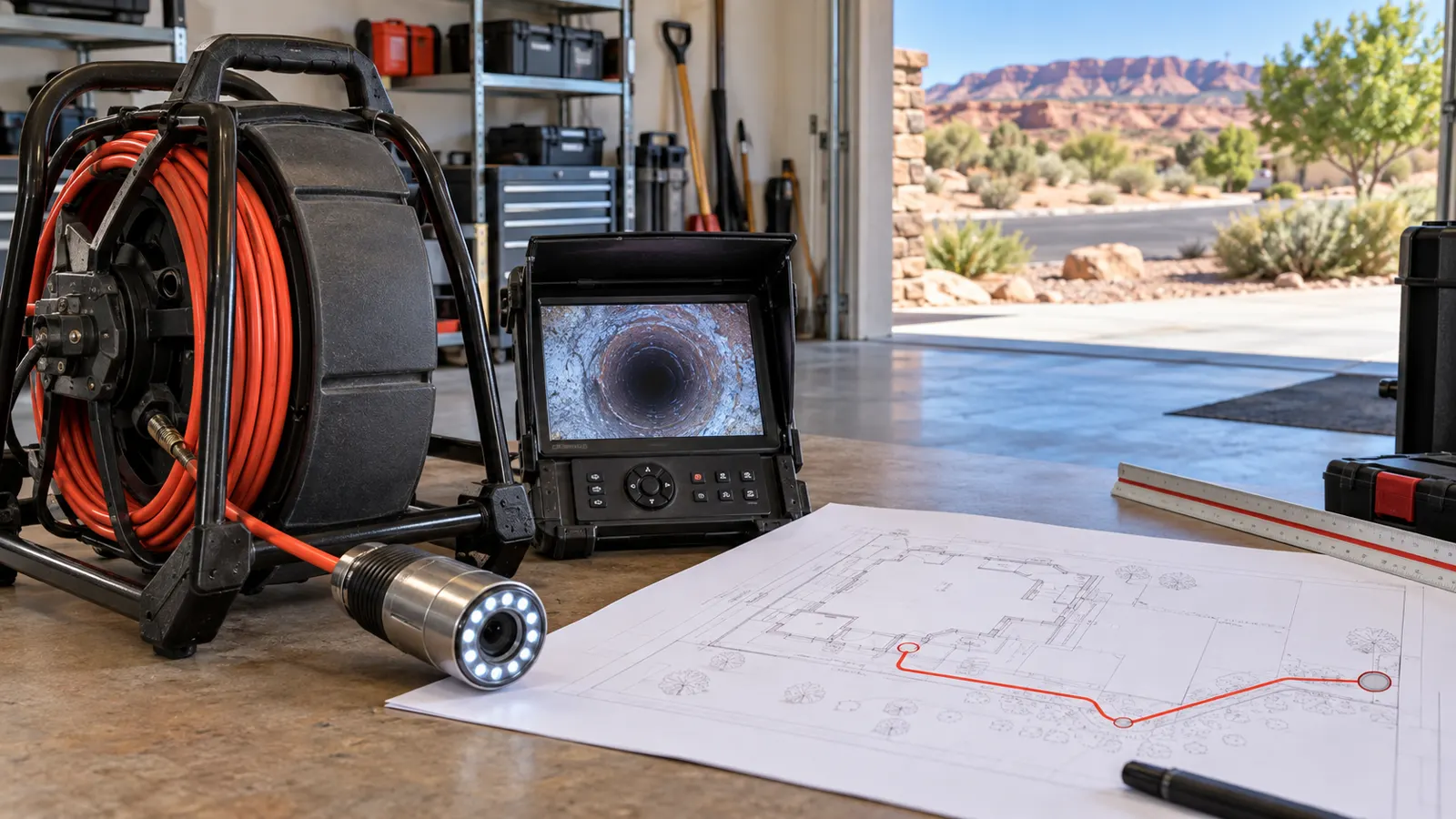
The output is a record, not a verdict. A technician feeds a camera through an access point and captures video of the line's interior, usually alongside a measurement of how far the camera has traveled from that access point.
Many inspections also include a locate, in which a signal from the camera head is traced from above ground to mark where a specific point in the line sits relative to the yard, driveway, or slab. Distance and position are separate pieces of information, and a scope usually needs both.
What the video does not do is announce a repair method. Interpretation happens afterward, when the findings are read together with the conditions at the property.
Location: where the finding sits along the line
Location is the first question because it changes almost everything downstream. A finding a few feet from an interior access point and a finding near the property line are different jobs even when the video looks similar.
Location also determines whose line is involved. The segment running from the home to the connection point is generally the property owner's responsibility, while the portion beyond it belongs to the utility. Where that boundary falls for your address is confirmed during the evaluation, not assumed from the video.
And location tells the professional what sits above the finding. A point under open lawn, a point under a driveway, and a point under a finished interior slab each carry different considerations, even when the pipe condition is identical.
Extent: the length of line involved
The second question is the length of line the findings cover. A single defect at one measured distance is a different scope than a condition appearing repeatedly along a long run.
This is where the camera's distance readings do their real work. A professional reads the footage as a map, noting where each observation appears and whether the stretches in between look consistent. Several findings clustered in one section suggest a localized scope. The same findings spread across the full run suggest something broader.
Extent is also why an inspection usually covers the whole accessible length rather than stopping at the first thing worth noting. The first finding is rarely enough information to define a plan.
Pipe condition: material, joints, and what the surface shows
The third input is the state of the pipe itself. Homes in the St. George area were built across many decades, and the material in the ground varies with the era of construction. Material affects how a line ages and which approaches are workable.
Condition covers several observations at once:
- The apparent material and how it presents on camera
- The state of joints between sections
- Whether the pipe's shape appears intact along the run
- Surface condition on the interior wall
- Whether water stands anywhere along a stretch that should drain
- Whether the camera's path is obstructed, and where
Two lines can show the same symptom in the house and very different conditions on video. That is the main reason a plan cannot be written before an inspection.
Access: what sits between the work and the line
The fourth input is everything above and around the pipe. Access is a property question rather than a plumbing question, and it frequently carries as much weight as the pipe condition.
The evaluation considers what surfaces sit over the line, how a crew and equipment would reach the area, how close the line runs to foundations or mature landscaping, where existing access points are, and whether other buried utilities share the corridor. Depth matters too, since a shallow run and a deep run are different undertakings.
Access is also why two neighbors with nearly identical findings can end up with different plans. The pipe is only part of the picture.
How the four inputs become a scope
A professional reads the four findings together rather than in sequence. Location and extent define where and how far. Pipe condition defines what the material can support. Access defines what is workable at the property without creating a second problem.
Those inputs are then weighed against the household's situation, including the drainage history you documented and how the property is used. The result is a proposed scope of work with a stated reason for each element, which is the part worth reading closely.
Ask which finding drove which decision. A scope that traces back to specific observations is one you can evaluate. A scope presented without that connection is harder to assess, regardless of how the video looked.
Why a method is not promised in advance
Homeowners often arrive having already heard about a particular approach and hoping to confirm it. It is a reasonable instinct, and it is the one thing an inspection cannot settle ahead of time.
No repair method is suitable for every line. Whether any given approach is workable at your address depends on the same four inputs, and those are unknown until the line has been inspected and the property evaluated. A method promised before that point is a guess wearing a confident tone.
The useful version of this conversation happens after the findings exist. At that stage you can ask what the options are, what each one requires at your property, and what would rule one out. You can review how West Desert Plumbing, Heating & Air approaches sewer line repair for St. George homes as background before that discussion.
What to bring to the conversation
Come with your own record. The drainage history you wrote down, the fixtures involved, and your notes on property access all give the findings context that video alone does not carry.
Then ask for the scope in writing, with the findings that support it. A written scope you can compare against the inspection record is the point of the whole exercise, and it is what makes the finished work checkable later.
To arrange an evaluation of your St. George line, contact West Desert Plumbing, Heating & Air and bring your notes to the visit.
Before a service visit
Four details that improve the diagnosis.
- Location and depth of the finding
- Extent and surrounding pipe condition
- Line material and access points
- Surface and landscaping constraints
Sources and review
Authoritative references.
This resource was updated on . The references below support the safety and maintenance framework used on this page.
- WaterSense home maintenance guidance (opens in a new tab)U.S. Environmental Protection Agency